Water Leak Detection in Bakersfield
24/7 water leak detection in Bakersfield and surrounding areas. IICRC-certified, insurance billing accepted. Call (661) 393-9306.
A water bill that jumps without explanation, a warm spot on the slab, a faint musty smell near a baseboard with no visible stain yet: these are the early signals of a hidden leak, and they almost always mean water has already been moving for weeks before anyone notices. Slab leaks and in-wall plumbing failures don’t announce themselves with a flood. They show up as a few dollars of unexplained usage, a soft patch of flooring, or a hiss you can only hear when the house is quiet. Catching it before drywall, flooring, or foundation soil is compromised is the whole point of leak detection.
What water leak detection actually involves
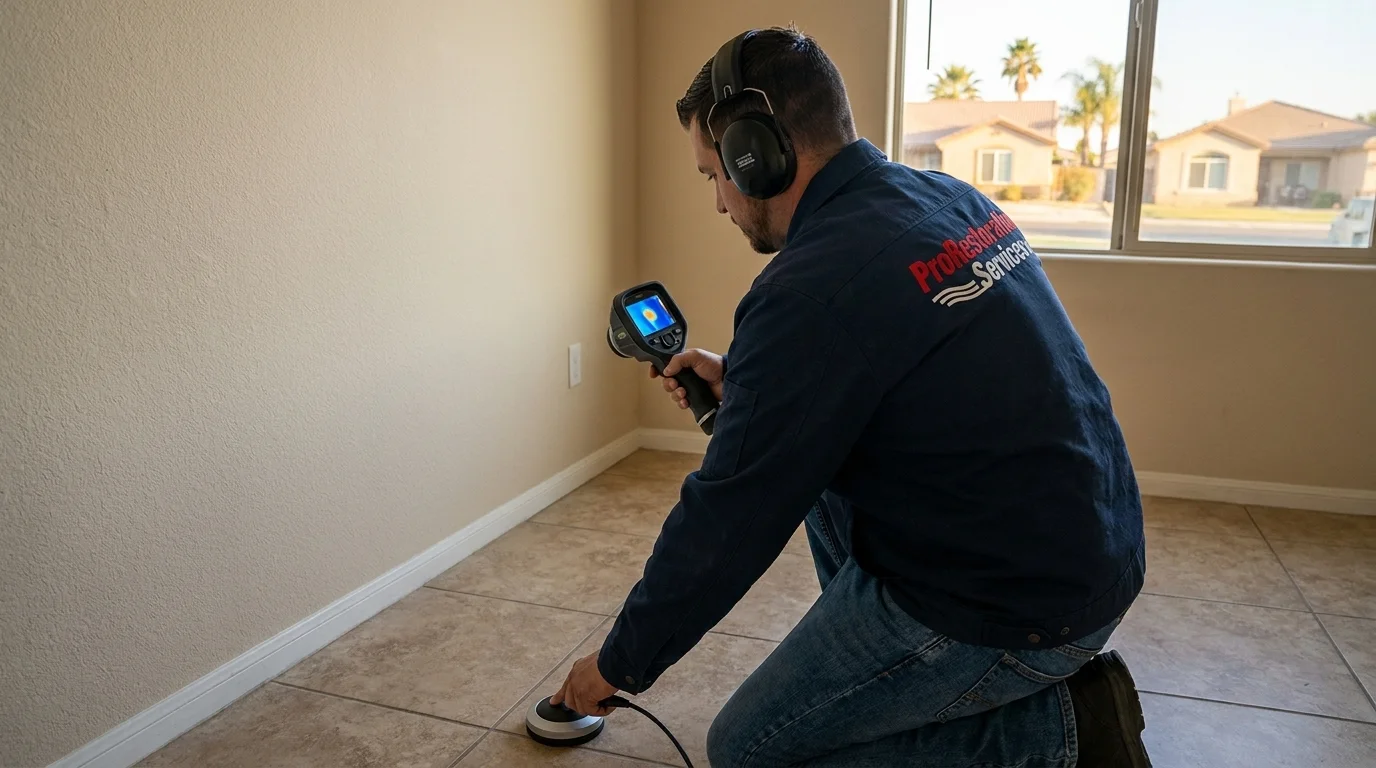
Finding a leak that isn’t visible requires instruments, not guesswork. Our technicians use acoustic listening devices to pick up the sound of water moving through pipe under pressure, thermal imaging cameras to map temperature differentials in walls and flooring, and moisture meters to confirm where water has actually traveled versus where it just feels damp. For slab leaks specifically, we isolate sections of plumbing and use pressure testing to narrow the leak to a specific run of pipe before anyone cuts into concrete. The goal at every stage is to locate the source precisely enough that repair work is targeted instead of exploratory. A typical detection visit runs one to three hours depending on the size of the home and how many fixtures and plumbing runs need to be checked.
Our process
- Usage and symptom review. We start with what you’ve noticed: a water bill spike, a sound, a damp spot, a specific room. This narrows the search area before any equipment comes out.
- Acoustic and thermal scanning. We listen for the signature sound of a pressurized leak and scan walls, floors, and ceilings for temperature anomalies that indicate water movement behind the surface.
- Moisture mapping. Using penetrating and non-penetrating meters, we document exactly how far the water has spread through framing, drywall, insulation, or slab, not just where the leak originates.
- Isolation and pressure testing. For suspected slab or in-wall leaks, we isolate plumbing zones and pressure test to confirm the leak’s location to within a small, specific area.
- Written findings and scope. You get a clear report: where the leak is, how far the water has traveled, and what it will take to repair the plumbing and dry or restore the affected materials.
What separates a good leak detection response from a bad one
The most common mistake in this work is stopping at “we found moisture” instead of mapping how far it’s gone. A leak that’s been running for three weeks doesn’t just wet the pipe chase, it can wick along a wall plate, travel down into a slab’s sub-base, or saturate insulation several feet from the actual source. Operators who skip thermal imaging or moisture mapping often miss secondary damage, which means the homeowner pays for a plumbing repair and then discovers rot or mold months later. Insurance adjusters reviewing a claim want to see documented readings, not just a verbal description of “it was wet.” We photograph moisture meter readings, thermal images, and acoustic findings as part of the written scope, because that documentation is what supports a clean claim if repair or restoration work follows.
What does water leak detection cost?
Costs vary based on how accessible the plumbing is, whether the suspected leak is in a slab or a wall, and how much area needs to be scanned. These are typical industry ranges, not a quote: every property and every leak is different, and ProRestoration Services provides a written scope before any work begins. Homeowners insurance often covers the cost of detection when it’s tied to a covered water loss, though policies vary on whether they cover detection alone versus detection plus repair; we can help you understand what your policy addresses.
| Scenario | Typical range |
|---|---|
| Single fixture or appliance leak check | $200 - $450 |
| Whole-home acoustic and thermal scan | $350 - $750 |
| Slab leak detection (isolation + pressure test) | $500 - $1,200 |
| In-wall leak with moisture mapping | $400 - $900 |
| Detection combined with follow-up moisture monitoring | $600 - $1,400 |
Seasonal & regional considerations
Bakersfield’s clay-heavy soil expands and contracts with seasonal moisture swings, and that movement puts stress on slab plumbing in homes built on a concrete foundation, which describes a large share of the valley’s post-1960s housing stock. Summer ground shrinkage followed by winter rain can shift a slab just enough to stress a joint that’s been fine for years, which is why slab leaks here often surface or worsen in late fall and winter. Older copper plumbing, common in homes built before the 1980s, is also more prone to pinhole leaks as it ages, regardless of season.
Service area
We provide water leak detection throughout Bakersfield and the surrounding Kern County communities, including Oildale, Rosedale, Shafter, Delano, and Tehachapi, with equipment set up to handle both slab-on-grade and raised-foundation homes common across the valley.
If your water bill doesn’t match your usage, or you’ve noticed a damp spot, a musty smell, or a sound you can’t place, don’t wait for it to become visible damage. Call (661) 393-9306 day or night to schedule a leak detection visit and get a written scope before a small leak becomes a structural repair.
Services We Handle
- Leak Detection
- Pipe Leak Water Damage
Frequently Asked Questions
Does homeowners insurance cover water leak detection?
How do you find a leak inside a wall without tearing it open?
What's the difference between a slab leak and a regular pipe leak?
How long can a hidden leak run before it causes real damage?
What should I do while I'm waiting for a leak detection appointment?
Looking for the best water leak detection company in Bakersfield?
ProRestoration Services provides licensed and insured water leak detection in Bakersfield, CA and the surrounding area. Customers rate us 4.8 out of 5 stars across 117 Google reviews. We answer calls 24/7 — call (661) 393-9306 for immediate help.
Need Water Leak Detection now?
We respond 24/7 across Bakersfield and surrounding CA cities.
Related Coverage
- Our Restoration Services
- Contact ProRestoration Services
- Restoration Services in Arvin
- Restoration Services in Bear Valley Springs
- Restoration Services in Buttonwillow
- Restoration Services in Delano
- Restoration Services in Dustin Acres
- Restoration Services in Keene
- Restoration Services in Lake Isabella
- Restoration Services in Lamont
- Restoration Services in Maricopa
- Restoration Services in McFarland
- Restoration Services in Oildale