Large Loss and Catastrophic Response in Bakersfield
24/7 large loss and catastrophic response in Bakersfield and surrounding areas. IICRC-certified, insurance billing accepted. Call (661) 393-9306.
When a loss spans multiple units, multiple floors, or multiple structures, the math changes. A single-family water loss might need three air movers and a dehumidifier. A 48-unit apartment complex with a failed riser on the fourth floor needs a mobilization plan, a crew that scales by the hour, and documentation detailed enough to support a claim that could run into seven figures. Large loss and catastrophic response is a different discipline from standard residential mitigation, and treating it the same way is how timelines slip and claims get disputed.
What large loss and catastrophic response actually involves
Large loss work covers commercial buildings, multi-family housing, industrial facilities, and any residential loss significant enough to involve multiple trades, structural engineers, or a general contractor working alongside the mitigation crew. Triggers typically include widespread fire damage across a structure, a burst main or sprinkler failure affecting multiple floors, storm damage to a commercial roof system, or any loss where the claim value or affected square footage puts it outside the scope of a standard residential job. The work itself uses the same core science, drying per IICRC S500 standards, soot and odor control, structural stabilization, but at a scale that requires industrial dehumidification, portable power, and a crew structure built around zones rather than rooms. Timelines stretch from days to weeks or months depending on the number of structures involved and whether reconstruction follows mitigation.
Our process
- Rapid triage and scope assessment. We walk the full affected area, structure by structure or floor by floor, to identify what’s salvageable, what’s a safety hazard, and what needs immediate stabilization before anything else happens.
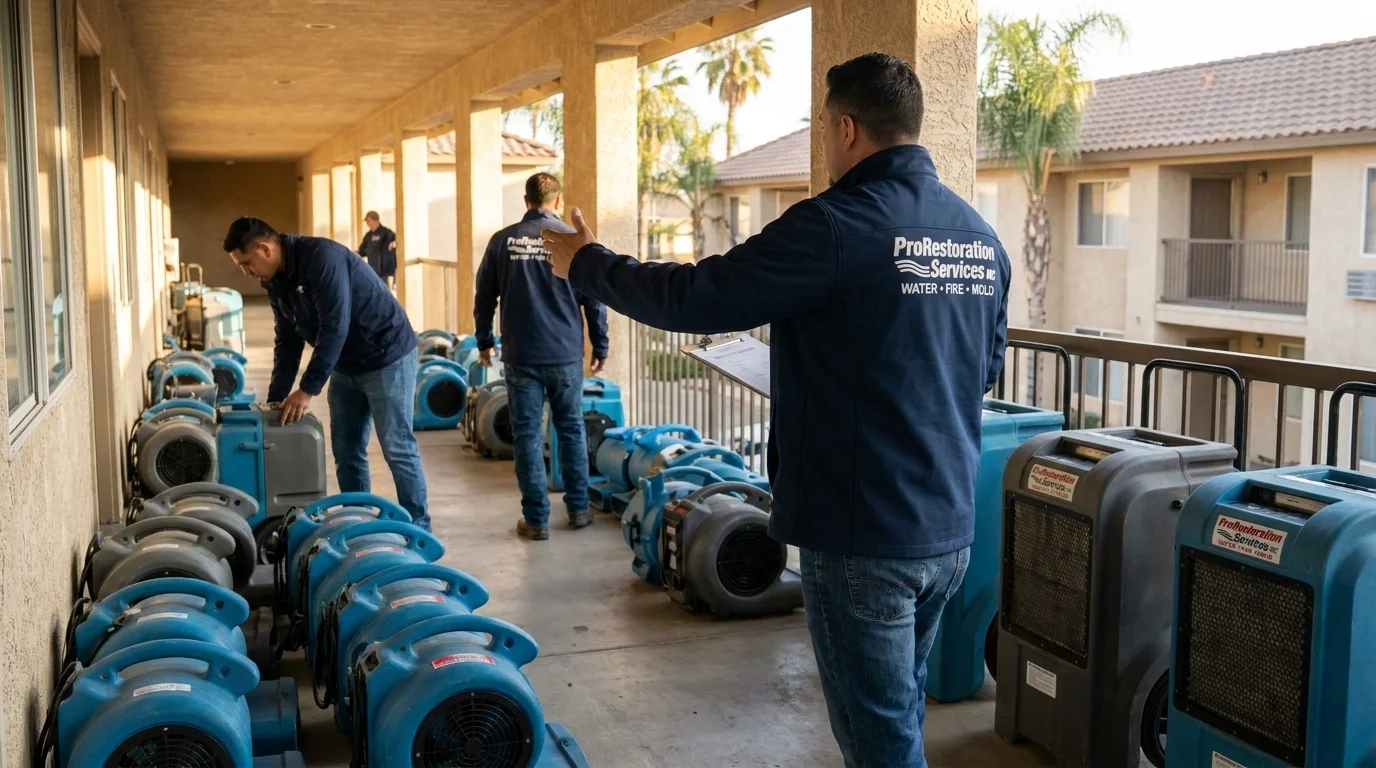
- Mobilization at scale. Large loss equipment, desiccant dehumidifiers, generator-powered extraction units, negative air machines, gets staged and deployed based on cubic footage calculations, not guesswork.
- Zone-based mitigation with daily monitoring. Psychrometric readings and moisture maps get logged across every affected zone so drying progress is tracked and documented the same way for a 2,000 square foot unit as a 200,000 square foot facility.
- Coordination with adjusters, property managers, and general contractors. One point of contact manages status updates, so the insurance side and the ownership side are working from the same information.
- Transition to reconstruction scope. Once drying is verified and documented, we build a written scope of work for rebuild, framing, drywall, finishes, so the project moves from mitigation to reconstruction without a gap in accountability.
What separates a good large loss response from a bad one
The most common failure on catastrophic jobs is under-equipping the site. A crew that treats a commercial loss like a scaled-up residential job will bring too few dehumidifiers for the cubic footage, and the drying numbers will plateau without anyone catching it until the adjuster asks why the timeline doubled. Good large loss response calculates equipment load against actual affected volume from day one and adjusts as readings come in.
The second failure point is documentation gaps. Adjusters reviewing a multi-million dollar claim want daily moisture logs, photos tied to specific zones, and a clear chain of equipment placement and removal. Missing or inconsistent documentation is one of the fastest ways a claim gets delayed or partially denied. The third is coordination breakdown: when mitigation crews, general contractors, and property management aren’t communicating through a single channel, duplicate work, missed access windows, and conflicting schedules eat days off the timeline. A dedicated project manager assigned to the loss, not just a crew lead, is what keeps a catastrophic job moving.
What does large loss and catastrophic response cost?
Costs for large loss work vary enormously depending on the number of structures, the extent of damage, and whether reconstruction is included. Every loss is different, and ProRestoration Services provides a written scope of work before any mitigation begins so the property owner and the adjuster are looking at the same numbers. Most commercial property and multi-family policies cover mitigation and reconstruction costs tied to a covered peril, though large losses often involve additional review from a carrier’s large loss unit or an independent adjuster.
| Scenario | Typical range |
|---|---|
| Multi-unit water loss, single floor | $25,000 - $75,000 |
| Apartment complex, multi-floor water intrusion | $100,000 - $500,000 |
| Commercial warehouse fire, partial structure | $250,000 - $1,000,000 |
| Mixed-use building, fire with full reconstruction | $750,000 - $3,000,000+ |
| Storm damage across multiple commercial roofs | $150,000 - $600,000 |
Seasonal & regional considerations
Bakersfield’s dry climate keeps routine mold growth slower than coastal cities, but it doesn’t eliminate the risk on a large loss site, especially in commercial buildings with HVAC systems that can spread moisture and spores across floors before anyone notices a problem. Summer heat adds another variable: catastrophic losses that happen during peak temperatures need faster equipment deployment because ambient conditions accelerate secondary damage. Winter storm events, while less frequent here than in other parts of the state, can still produce roof failures and water intrusion across commercial properties built with older flat-roof systems common in the Central Valley’s industrial and retail stock.
Service area
ProRestoration Services handles large loss and catastrophic response throughout Bakersfield and the surrounding Kern County area, including commercial corridors, multi-family housing developments, and industrial properties in neighboring communities.
If you’re managing a loss that spans multiple units, floors, or structures, the scope needs to be right the first time. Call (661) 393-9306 to start a large loss assessment and get a documented scope of work moving before the claim timeline gets away from you.
Frequently Asked Questions
What qualifies as a "large loss" versus a standard restoration claim?
How is equipment scaled for a catastrophic, multi-structure loss?
Who manages communication between the adjuster, the property manager, and the mitigation crew?
Does insurance cover large loss and catastrophic restoration?
How long does mitigation take on a large commercial loss before reconstruction can start?
What kind of documentation do you provide for a multi-million dollar claim?
Looking for the best large loss and catastrophic response company in Bakersfield?
ProRestoration Services provides licensed and insured large loss and catastrophic response in Bakersfield, CA and the surrounding area. Customers rate us 4.8 out of 5 stars across 117 Google reviews. We answer calls 24/7 — call (661) 393-9306 for immediate help.
Need Large Loss and Catastrophic Response now?
We respond 24/7 across Bakersfield and surrounding CA cities.
Related Coverage
- Our Restoration Services
- Contact ProRestoration Services
- Restoration Services in Arvin
- Restoration Services in Bear Valley Springs
- Restoration Services in Buttonwillow
- Restoration Services in Delano
- Restoration Services in Dustin Acres
- Restoration Services in Keene
- Restoration Services in Lake Isabella
- Restoration Services in Lamont
- Restoration Services in Maricopa
- Restoration Services in McFarland
- Restoration Services in Oildale